A conference on Transport, Climate Change
and the Scottish Executive's National Transport Strategy
Monday 8th May 2006 - The Hub, Castlehill, Edinburgh
- Conference report - detailed report by Konstanze Glaser
- 1.
Background to conference
It is widely accepted that climate change is the biggest environmental threat to our planet, and we know that the share of transport in the UK’s current total production of greenhouse gases has reached about 25% (not including emissions related to petrol production). In fact, that share is expected to rise significantly, as CO2 emissions in other sectors continue to fall and levels of motorised traffic (road, rail and air) increase. The UK government committed itself to keeping greenhouse gas emissions at 12.5% below 1990 levels during 2008-2012 (Kyoto Protocol) and to achieve a 20% reduction in carbon dioxide emissions by 2010, with the Scottish Executive promising to reducing the ‘Scottish share’ of the UK totals and adopting as a key objective within the transport sector that traffic levels would stabilise at 2001 levels by 2021. Yet transport policies across the UK fall short of what is required for reaching those targets.
What’s more, the Scottish Executive is on the verge of going back on its promise to reduce traffic levels. The 2005 Report of the Scottish Parliament's Environment and Rural Development Committee Climate Change Inquiry concluded that not only should the Executive keep the 2002 targets but that "a series of interim targets towards the 2021 traffic stabilisation goal should be developed in order to provide a realistic route map towards reducing emissions from this sector". However, the Executive’s National Transport Strategy consultation paper (2006) indicates that the 2002 targets will be adjusted upwards (Consultation Question 58, No. 32f) and no interim milestones be adopted because the unavailability of hard-hitting financial measures (vehicle taxation, fuel tax) made "ongoing increases in road traffic" inevitable and interim targets "meaningless" (ibid, No. 28 and 37).
The Scottish Executive has also failed to live up to public expectations with regard to relevant local authority action. It claimed that it would support local authorities in implementing road user charging, yet Scottish Executive ministers went into hiding when the City of Edinburgh Council brought forward its congestion charging plans for referendum (February 2005), and earlier this year threw out the proposal of the Forth Estuary Transportation Authority (FETA) for variable toll levies on the Forth Road Bridge. Despite the ongoing success of similar schemes in London and Stockholm, the Executive's failure to take a lead in this area has killed off positive action on this front for the time being.
Thirdly, the Scottish Executive pressed ahead with urban motorway building in the shape of Glasgow’s M74 even though it was comprehensively rejected in an independent Public Local Inquiry (2003-04) where the opposition was led by JAM74 and Friends of the Earth Scotland (FoES), with support from TRANSform Scotland. The Inquiry Reporter concluded that the new motorway would be bad for the environment, bad for social justice and bad for the economy.
In relation to Aberdeen, the Executive has failed to consider alternatives to a motorway project that will effectively destroy the western green belt of Scotland's third biggest city (the Aberdeen western bypass), whilst doing little or nothing to improve conditions for commuting into and out of the city at peak hours. The transport minister's comprehensive mismanagement of the process has brought forward widespread threats of legal action from local residents.
Finally, and most importantly from a climate change perspective, the Executive must be criticised for promoting short-haul aviation by handing out subsidies to airlines from its Air Route Development Fund. Not only is air transport the most climate-damaging mode of transport; such subsidies do not make sense in narrow economic terms as the air transport industry operates as a net import to the Scottish economy, flying out more cash than it brings in. In fact, there are outstanding questions regarding the legality of such subsidies. - 2.
Conference
objectives
The 'Facing the Flood' conference aimed to offer participants cutting-edge information on:
- the extent to which our travel needs and travel choices need to change;
- how successful existing policy initiatives to this end have been; and
- the merits and drawbacks of alternative policy frameworks and measures.
Presentations
and contributions from the floor reminded participants of the seriousness
of the situation, confirmed that reducing our need to travel and a shift towards
sustainable modes must be at the heart of any Scottish and UK-wide climate
change prevention agenda, and set out in great detail how significant changes
in travel behaviour can be achieved.
We are most grateful to everyone who came along for the day to share their
expertise and opinions - speakers as well as audience members. We would also
like to thank David Spaven for hosting the morning sessions (1, 2) and summing
up, and Rob Edwards (Sunday Herald) for acting as chair during the afternoon.
Last but not least, we wish to express sincere thanks to those who contributed
to the success of the event in a less prominent fashion: conference organiser
Susan Warren, TRANSform Scotland staff members Colin Howden and Siobhan
Riordan, and several of our organisation’s volunteers.
- 3. Conference presentations
- Richard
Dixon (WWF Scotland)
The Challenge of Climate Change and the Need for Action
The conference began with Richard Dixon (WWF Scotland) summarising recent evidence of climate change and considering practical implications of current trends for different parts of the world in the medium and long term. Engaging critically with competing hypotheses of 'safe' levels of CO2 emissions, he predicted that a rise of two degrees by 2100 is almost certain and argued that the ‘predict and provide’ approach to transport planning and 'will look into it' responses to criticisms from environmental pressure groups are extremely irresponsible.
While aviation is by far the most harmful factor in the transport context, individual motorised road transport too must be reduced as a matter of urgency, which requires courageous political leadership, rather than endless time-consuming rounds of consultations. Edinburgh’s attempt to introduce congestion charging (2004/05) was a lost opportunity in this respect, and the new National Transport Strategy is our best opportunity to initiate changes for the better at present, though it would not really deliver on the CO2 reduction front until 2020.
A more immediately effective step would be the abandonment of the Air Route Development Fund (which has resulted in absurdities such as subsidies for flights between Inverness and Newcastle, where a good train service already exists). During the subsequent Q&A session, Dixon urged decision makers to approach CO2 emissions monitoring with the same rigour as cost analyses, so that no project is given the green light unless its climate change implications have been established and found acceptable.
- Frances
Duffy (Transport Scotland)
Transport Scotland and the National Transport Strategy
Frances Duffy (Transport Scotland) provided useful insights into the way in which climate change considerations have, or rather have not, been shaping "the Scottish Executive’s vision to deliver sustainable transport in Scotland". While "protecting the environment" is one of Transport Scotland’s official objectives (cf. Slide 9), we were left with the impression that Scotland’s transport planners continue to worry much less about climate change than about economic growth, to which end road building receives considerably greater amounts of funding than climate friendly alternatives to motorised road travel.
Indeed, the Scottish Executive seems "stuck in last century's 'predict and provide' road-building mindset, oblivious to the earthshaking challenges posed by pollution and the rising global temperatures it causes" (Rob Edwards 'Transport Scotland: blinded by mud'). It was however reassuring to hear that the needs of non-drivers are being addressed with measures to “extend” and improve access to public transport and that there is an explicit commitment to achieving a higher degree of transport integration, though it is quite doubtful that gradual improvements in this area will achieve much in the way of modal shift and overall traffic reduction. It also remains to be seen whether the STAG transport project appraisal system represents a reliable enough procedure to keep a tab on CO2 emissions that can be attributed (indirectly) to future infrastructural developments.
- Tim
Taylor (Metroecomica)
Costing the Impacts of Climate Change in the UK: Examples from the Transport Sector
Tim Taylor (Metroecomica) considered in some depth financial aspects of climate-related changes in the UK's transport sector. His sources included research projects focusing on particular sectors of the economy or on specific climate events (severe weather) as well as DEFRA’s ongoing cross-regional study into the "cost of impacts and adaptation".
It was clear that not all consequences of climate change are harmful (cf. Slide 14), but there is no doubt that negative impacts due to severe weather (rail buckling, subsidence, disruptions to road, ferry and air travel) will outweigh by far any possible gains (e. g. reduced need for gritting) and secondary benefits (e. g. reduced noise levels due to road resurfacing). Indeed, more frequent infrastructure repairs are likely to require a substantial top-up of local highway maintenance budgets.
Equivalent pictures are starting to emerge with regard to health, water and electricity services and other areas of our everyday lives, which were briefly acknowledged at the end. While the number of relevant studies undertaken to date may be quite low, their findings suggest that climate change is going to cause the UK’s economy considerable costs.
- Professor
Abigail Bristow (Loughborough University)
Low Carbon Transport Futures: How Can we Get There?
The first speaker to address specifically how carbon emissions from transport can be reduced in a UK context was Abigail Bristow (Loughborough University / Tyndall Centre for Climate Change Research). Having set the scene with a comprehensive account of the relationships between transport levels, emissions reductions and likely implications for global temperatures, she compared the likely outcomes of several hypothetical traffic level scenarios till 2050 and predicted carbon baseline emissions between 10 MtC (for a reduction target of 80%) and almost 50 MtC (do nothing - high).
The remainder of the presentation (see Slide 10ff) was devoted to the relative and combined efficacy of interventions: from technological improvements (low emissions vehicles), economic instruments (fuel duties, road user charging) and incentives to use public transport (fare reductions, service improvements), to increased use of tele-conferencing and 'soft measures' (cf. Jillian Anable). For obvious reasons, the impact of the latter steps is rather more difficult to assess than the effectiveness of the former. Matters are also complicated by the fact that more attractive and accessible railway services are more likely to persuade drivers out of their cars than bus services but are also expected to reduce cycling and prompt existing public transport users to undertake more journeys.
It was also very useful to be reminded that a proper estimate of carbon emissions starts at the oil well, rather than inside each car (the 'well-to-wheel' approach), that the promise of technofixes (60% improvement, assuming a 25% traffic increase) is 'very ambitious' given current rates of improvements, and that gains in emissions rates are offset by the increased weight of new vehicles (cf. Aat Peterse). However, there is every reason to believe that a combination of all of those measures would enable the UK to reach at least the weaker of the two proposed targets (15 MtC by 2050; Slide 22). Current transport policies contain evidence of "successes" and moderate progress, as well as "no real progress" and "gaps" (Slides 23-28).
- Jillian
Anable (UK Energy Research Centre & Robert Gordon University)
Soft Measures: Smart choice or soft option?
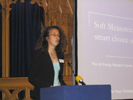
Addressing the same general question, Jillian Anable (UK Energy Research Centre) focused on ‘soft measures’, which, she stressed, are still eluding a universally useful definition and often cannot be completely separated from 'hard measures' (cf. examples on Slides 3 and 4). Targeting the psychological level, their significance as transport management tools is greatest in relation to travel mode choices and whether or not we decide to travel.
The main section of the presentation covered relevant results from two recent studies: Making Smarter Choices Work (Sally Cairns et al., DfT 2004) and Perceptions of Travel Awareness (Scottish Executive, 2005). While some 'soft' measures tend to greater overall effects than others (cf. Slide 14) and some groups are more responsive to them than others (cf. Slides 28-35), it is quite clear that all of these measures are important and that their benefits should be "locked in" with 'hard' measures such as road pricing, bus lanes, improved conditions for cyclists and pedestrians and/or parking constraints. Anable also confirmed that such an approach would represent very good value for money (cf. Slide 15).
Åsa Romson (Stockholm City Council)
The Stockholm Trial: Congestion charges in Stockholm
Åsa Romson (Stockholm City Council) provided a summary of Stockholm’s congestion charging experiment (3 January – 31 July 2006), which became viable after Sweden’s Green Party (Miljöpartiet de Gröna) gained power at the local (as part of a coalition) as well as national level (September 2002). In the first section of her presentation, Romson covered the population base and transport logistics of the greater Stockholm area, previous levels of motorised road travel and public transport use, and their environmental as well as economic implications.
The remainder of her talk was devoted to the specifics of the city’s seven months long congestion charging trial (charging area, charging times, price etc – cf. Slides 4, 5, 6), which goes hand in hand with improvements to public transport services (such as the provision of 200 new buses) and will continue or cease in a referendum scheduled for 13 September 2006.
Given the obvious success of congestion charging in Stockholm (20% reduction in traffic and a 70% reduction in traffic jams – cf. Slide 7), the relatively fair coverage it has been given by the media, and the hard edge of likely alternatives (temporary road closures, more stringent parking regulations etc.), Stockholm city council is cautiously optimistic that this particular version of a carrot and stick approach to urban traffic growth will win majority approval. In any case, this project can be said to give the transport planners of Scotland’s councils as well as the Scottish Executive plenty of food for thought.
- Aat
Peterse (European Federation for Transport and Environment, Brussels)
The Case for a Lower Carbon Cars Policy
Aat Peterse (T&E) took us back into the terrain of technofixes, whose potential to bring down greenhouse gas emissions in the transport sector is widely overrated, but which nevertheless deserve to be taken seriously as a component of climate-friendly transport policies. So far, European climate policy for cars has largely been a failure.
Voluntary commitments on the part of car producers alone seem unlikely to hit the current EU target of 120g CO2/km (or less) by 2010, and Peterse’s presentation offered an overview of what can, and should, be done about that.
The way ahead in this field appears to consist of (1) technical innovations such as lighter materials (to reverse the current weight gain new car models by about 20kg per year) and the types of adjustments VW offers with its Blue Motion range (cf. Slides 8 and 9), (2) better consumer information, and (3) more radical uses of taxation (cf. Abigail Bristow). A very obvious target for the latter are SUVs, whose anti-social impact in the urban environment is well documented: their size and design pose a much greater danger to life and limb than ordinary cars.
Concerns about a potential competitive disadvantage can be alleviated by EU-wide fuel efficiency standards, as the recent introduction of equivalent regulations in the US (CARB) and China illustrates.
- Arthur
Leathley and Allan McLean (Virgin Trains)
Virgin’s success in reducing air trips between Manchester and London
The last two presentations covered the role a climate-friendly transport strategy should allocate to rail services. Arthur Leathley and Allan McLean (Virgin Trains) reported on efforts by Virgin Trains to bring about modal shift from aviation to rail, explaining in particular how passengers were won over on the Manchester-London route.
According to Virgin’s own analysis, success in this area came down to six factors: punctuality, frequency, speed, price, publicity and a 'success-breeds-success' rule. It was clear, though, that train companies can only do so much. Track upgrades and related safety aspects depend on investment from other sources, and while most train service providers are still able to come up with sufficient special rates to beat airlines in the ticket price department, a lot more could be gained in this respect with the introduction of taxes on aviation fuel.
If Virgin’s plans are anything to go by, high-speed rail may also retain and gain new customers through on-board facilities (such as wi-fi and mobile phone connections, full evening meals and chauffeur services), as well as an increase from 125 mph to 135 mph top speed between Glasgow and London). It was noted that the latter, plus other selected upgrades to the existing West Coast Main Line would allow Virgin to secure journey times of 3 hours 45 minutes or less. This would be seriously competitive with the airlines, since rail also has the attraction of an uninterrupted journey and space to work and move around.
Professor
Roger Kemp (Lancaster University)
The Environmental Impact of High-Speed Rail
While there is a broad consensus amongst environmentalists that rail travel
is vastly preferable to short-haul aviation, the relative energy efficiency
and CO2 merits of high-speed and ultra-high-speed rail services in comparison
to air and car use are less well know, which made the contribution of Roger
Kemp (Lancaster University)
both fascinating and very valuable.
Dismissing hydrogen and electric cars as 'clean' short-term alternatives (given
the emissions and other environmental costs they would currently cause at
the fuel/electricity-production stage), Kemp talked about timescales for rail
technology improvements (e.g. the construction of new high-speed rail lines),
and about the factors that make different types of motorised travel (plane,
electric and diesel train, car) more or less fuel-efficient: speed, seat numbers
and load factors.
An ideal rail travel scenario would combine high capacity, lightweight, low-drag
train technology with 'modest' top speeds (200-250km/h) on upgraded existing
main lines, non-carbon energy sources and high levels of patronage. Short
of achieving such favourable circumstances, we should be reluctant to endorse
modal shift from heavily loaded planes (or smaller cars with three or more
passengers) to entirely new high-speed rail routes on the basis of potential
energy and emissions savings. See Slides 26 and 27 for further conclusions.
- 4.
Conclusion
David Spaven, Chair of TRANSform Scotland, concluded the day by setting out five priorities for action in the new Scottish Executive National Transport Strategy:
- a national programme for road traffic reduction;
- a review of transport expenditure so that investment reinforces sustainable transport rather than damages progress towards it;
- funding for local authorities to be linked to action on climate change;
- government taking the lead in implementing a national road charging scheme;
- campaigns to change public perceptions, based on Scotland’s successful recent smoking ban as well as well-known successes in the transport field (e.g. use of seat-belts and reduction of drink-driving).
- The new National Transport Strategy can be consulted on-line at http://www.scotland.gov.uk/Publications/2006/05/16112258/0 and comments should be submitted by 13 July 2006.
- We hope that the insights and assessments shared at this event will promt a large number responses which note the insufficient reflection of climate change concerns in the current version and urge the Scottish Executive to take a lead in bringing about a UK-wide paradigm shift in this field that corresponds to the severity of the situation.

Richard Dixon

Frances Duffy
Tim Taylor

Abigail Bristow
Jillian Anable

Åsa Romson

Aat Peterse

Allan McLean and Arthur Leathley
Roger Kemp
