

- Background
to the conference
Home Zones area people friendly residential streets based on ideas that developed originally in the Netherlands, and have become ordinary practice in many parts of Europe. The concept is now generating many interesting schemes across the UK, with varying degrees of success and difficulties.
‘A Challenging Experience’ , the fourth Scottish Home Zones conference, was organised by the Home Zones Scotland Network, and the Scottish Executive. It was hosted by the Scottish Executive at its Victoria Quay headquarters on 26 September 2005.
This conference provided a platform for sharing learning about how to build Home Zones into our streets. With 59 completed Home Zone schemes in England and Wales, good practice guidelines are being developed. The slower progress on Home Zones in Scotland emphasized the need for such guildelines, despite the increased level of awareness in Scotland that was revealed in national survey launched at the conference. The survey report 'Changes in Priority?' is available for download [PDF 247Kb].
speakers
- The conference
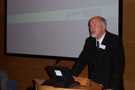
was chaired by David Spaven from TRANSform Scotland.
In his opening remarks, he brought up two issues which continued to be recurrent
themes throughout the day: the need for joined-up thinking on Home Zones,
and the variable funding availability in different local authorities.
John Barrell, a Technical Director of Jacobs Babtie and Project Director for the Home Zones Challenge Programme in England, was first to present. He started the day on an encouraging note, claiming that the 57 schemes he oversees are largely successful, and pointed to some of the interesting wider impacts such as crime reduction and community responsibility. One point that he emphasized was the fact that no two schemes are the same: although the engineering elements may be, the community priorities are not, making the application of every Home Zone a unique experience. With the need to involve the community at all levels, he called for cross-discipline working across all sectors and all departments.
Khalid Muneer, Group Engineer at Kirklees Metropolitan Council and Project Manager of the Kirklees Home Zone, outlined the process of a retrofit scheme which totally changed a traffic-heavy area to a shared space for all. In his talk he focused on how they succeeded in getting the community involved through focus groups and knocking on doors, and how this helped to create successful partnerships between different interest groups.
Neil Frier, Team Leader at Gateshead Council, made an interesting comparison between two Wimpey new build estates in Gateshead: the flagship Staithes Home Zone development and the much less people-friendly Westoe Crown Village. The success of Staithes, reflected in its recent Housing Design Award, can be seen in the was that drivers are made aware they are ‘guests’. In the Home Zone the streetscape encourages social activities in its ample open spaces, whereas the spaces in less successful developments just tend to be filled with car parking.
Karen Esslemont, from EDAW, Phil Jones, of Phil Jones Associates, and Keith Gowenlock, from WSP Development, then presented the eagerly-awaited Scottish Executive Planning Advice Note (PAN 76). The new planning contains three main messages: context, identity and connection. The PAN sets basic parameters without prescribing solutions, as it is recognised that current Scottish standards do mitigate against flexibility. The PAN will be released at the end of October, and there will be a number of training sessions to accompany its launch.
Ian Wall, Chief Executive of EDI Group Ltd., gave an impassioned and inspiring presentation on the social roots of 'shared space' and the need to focus on how to share the street. Some fascinating examples from the Netherlands illustrated how designing areas for people rather than for vehicles does work, and how the 'less is more' approach can succeed for pedestrians and drivers alike.
Tavish Scott MSP, the Minister for Transport, addressed the delegates with a message about the need to aim towards changing people’s behaviour by moving people out of the car and into public transport. He defended the Scottish Executive’s funding of Home Zones through local authorities, and said that the 2007/08 budget will allow options for changes in spending.
Sue Gutteridge, a founder member of Home Zones Scotland Network, pointed out the need for the Scottish Executive to adapt and expand opportunities for learning from the Scottish pilots. She outlined the encouraging findings of the national survey, where more Home Zones are underway than was expected. She showed how this emphasized the need to disseminate information to a wider audience, calling for more funding to be made available for this.
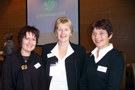
Three Scottish case studies ended the conference. Lorna Simpson, of Ormlie Community Association, talked inspiringly about the success of the Ormlie Home Zone, part of a wider regeneration project. The change from a drab, stark, grey estate to one with colour, life and wavy walls was seen through photographs which helped delegates to see that anything is possible. Diane Holmes, an Ormlie resident, told us how her own attitude towards the scheme had totally changed, and that she was now proud to be involved and happy to bring up a family on the estate.
Ray Walkinshaw, of Southside Housing Association Ltd. in Glasgow, provided the positive perspective of a landlord on changing the streetscape and the wider environment.
Clare Hunter, consultant on the Craighall Home Zone in Stirling, outlined how to overcome some of the difficulties in getting an introspective homogenous community to participate and overcome their inertia in starting a Home Zone project.
conclusions
All speakers, representing different roles within Home Zones, led to the conclusions that Home Zones are basically a win-win scenario. Nobody loses out – instead, everyone gains.
The recurrent theme from each presentation was that there is a vital need to work more at developing links between all levels, from the communities to the Executive. If we are to move towards safer streets where people as well as vehicles can be, we need to get everyone on board right from the start.
The conference provided many examples of good practice, and the space to discuss some of the common difficulties faced in achieving results. Many pointed out the need to get planners and developers to buy into the fact that drivers will be more responsible and drive slower if the environment in which they are driving encourages them to do so. With proper dissemination of information to the right people, appropriately allocated funding, and real collaboration, Home Zones can reverse the past decades of irresponsible road building and car-centred developments.
Conference
report by Kate Barclay.


Khalid Muneer

Neil Frier



Keith Gowenlock, Phil Jones and Karen Esslemont

Ian Wall


Sue Gutteridge
presentation by Lorna Simpson
speech by Diane Holmes

Ray Walkinshaw

Clare Hunter
